
Plantar Fasciitis Exercises From Manhattan Sports Medicine
Plantar fasciitis responds better to loading the tissue than to resting it — which is why exercise, not time off, is the core of treatment.
The exercises below are the ones physical therapists at Manhattan Sports Medicine & Wellness Group prescribe most often, with the sets, repetitions, and frequency that make them work rather than a list to guess at.
Most cases improve substantially within six to twelve weeks. The word doing the heavy lifting there is consistent — these need to happen daily, not only when the foot hurts.
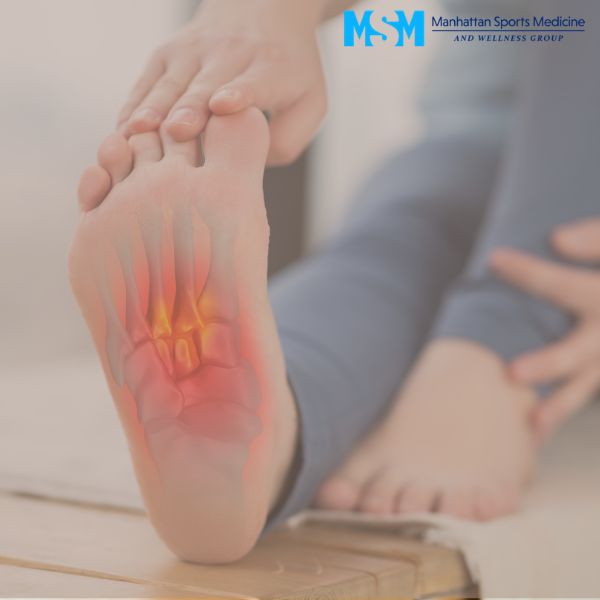
Why Exercise Works for Plantar Fasciitis
The plantar fascia is a thick band of tissue running from your heel to the base of your toes, supporting the arch every time you take a step. Plantar fasciitis is what happens when the demand on that tissue exceeds what it can tolerate — classically producing sharp heel pain with the first few steps in the morning, easing as you move, and returning after long periods of standing.
Three mechanical factors drive most cases, and each one is addressable:
- Limited ankle dorsiflexion — if your ankle cannot bend far enough as you walk, your foot compensates by collapsing through the arch, and the fascia absorbs the difference.
- Calf tightness — the Achilles tendon and the plantar fascia share a soft tissue connection at the heel. A tight calf pulls directly on the fascia, which is why treating the foot alone rarely resolves it.
- Weak intrinsic foot muscles — the small muscles inside the foot share arch support with the fascia. When they are weak, the fascia takes on more load than it was built for.
That is the reason a good programme includes stretching, strengthening, and mobility work rather than stretching alone.
Seven Exercises for Plantar Fasciitis
1. Plantar Fascia-Specific Stretch
The most important one on this list, and the one most people skip in favour of a calf stretch.
Sit down and cross the affected foot over the opposite knee. With one hand, pull your toes back toward your shin until you feel a firm stretch along the sole. Use your other hand to feel the fascia — it should tighten like a guitar string. Hold 10 seconds.
Prescription: 10 holds of 10 seconds, three times daily. Do the first set before your feet touch the floor in the morning — that is what blunts the first-step pain.
2. Gastrocnemius Calf Stretch
Stand facing a wall with your hands at shoulder height. Step the affected leg back, keep that knee straight and the heel flat on the floor, then lean forward until you feel the stretch high in the calf.
Prescription: 3 holds of 30–45 seconds per side, twice daily.
3. Soleus Calf Stretch
Same position, but bend the back knee slightly while keeping the heel down. The stretch moves lower, closer to the Achilles. This one matters as much as the straight-knee version and is more often missed.
Prescription: 3 holds of 30–45 seconds per side, twice daily.
4. High-Load Heel Raises
The strengthening exercise with the strongest support behind it, and the one most home programmes leave out.
Stand on a step with a rolled towel under your toes so they sit in extension. Rise onto the ball of the foot over 3 seconds, hold at the top for 2, lower over 3. Use both feet at first; progress to single leg as it becomes manageable.
Prescription: 12 repetitions, 3 sets, every other day. Add load with a backpack once single-leg becomes comfortable.
5. Short Foot Exercise
Sit with your foot flat. Without curling your toes or lifting your heel, draw the ball of your foot slightly toward your heel so the arch lifts. It is a small movement and it is harder than it sounds.
Prescription: 10 holds of 5 seconds, twice daily. Progress to standing, then to single-leg standing.
6. Toe Towel Curls
Place a small towel on the floor and use only your toes to scrunch it toward you. Keep the heel planted.
Prescription: 3 sets to fatigue, once daily. Add a light weight on the far end of the towel as it gets easier.
7. Big Toe Extension Mobility
Your big toe needs to extend properly for the arch to tension correctly as you push off. Sit with the foot flat and lift only the big toe, keeping the others down. Then reverse it — big toe down, others up.
Prescription: 15 repetitions each direction, once daily. Expect this to feel impossible at first; the coordination comes.
How to Progress and What to Expect
Start with the stretches and the short foot exercise. Add heel raises once morning pain has begun to settle, usually inside the first two weeks. Some discomfort during strengthening is expected and acceptable — the guide is that pain should return to its baseline within 24 hours of the session. If it is worse the following day, reduce the load rather than stopping altogether.
Realistic timeline: noticeable change in morning pain within two to three weeks, meaningful improvement by six to twelve weeks, and full resolution often taking several months. The strengthening work continues past the point the pain stops — stopping early is the most common reason it returns.
What Else Helps
Supportive footwear matters more than most patients expect — going barefoot on hard floors at home undoes a lot of daytime progress. Rolling the sole over a frozen water bottle for ten minutes eases symptoms without treating the cause, which makes it useful for getting through a bad day. Taping can offload the arch during activity while the strengthening work catches up; our guide to the science behind KT taping covers how that is applied.
If your pain sits further forward, under the ball of the foot rather than the heel, it may be metatarsalgia rather than plantar fasciitis — different condition, different programme. Our exercises for metatarsalgia cover that case.
When to See a Physical Therapist
Six to eight weeks of consistent home work with no improvement is the point to get assessed. So is pain severe enough to change how you walk, symptoms in both feet at once, or any numbness, tingling, or swelling — those can point to something other than plantar fasciitis.
An assessment measures the things you cannot check yourself: actual dorsiflexion range, where the tenderness sits, how your foot behaves under load while walking. That determines which of the exercises above matter most for you, and how aggressively to load. Our physical therapy team treats plantar fasciitis at all three Manhattan offices, working alongside our podiatry team when footwear or orthotics are part of the answer.
Frequently Asked Questions
How long until these exercises work?
Morning pain usually improves first, often within two to three weeks. Substantial improvement typically takes six to twelve weeks of daily work.
Should I stop running?
Usually you can keep running at reduced volume rather than stopping entirely, provided pain settles within 24 hours afterward. Complete rest tends to leave the tissue less tolerant than before, which is why it often feels worse when you return.
Do I need to do all seven?
Exercises 1, 2, 3, and 4 do most of the work. The remaining three address the intrinsic foot strength and toe mobility that reduce the chance of recurrence, so they matter more for prevention than for immediate relief.
Do night splints help?
They can, by holding the fascia at length overnight so the first steps in the morning are less painful. They work best alongside the loading programme rather than instead of it, and not everyone tolerates sleeping in one.
Get Your Plantar Fasciitis Assessed
If the heel pain has not shifted after weeks of stretching, the programme probably needs adjusting to your foot. Our physical therapists will assess what is driving it and build the plan around that — at whichever Manhattan office suits you.